The unknowns really piled up on this one. Could I close the record store at 7pm, catch the streetcar, and make it for a 7:30 show? Would Slimm be there selling vegan burgers so I could have a dinner before 11:00? Was the opener really a death metal act? Would the headliner play any of his old band's songs, and if so, would they be recognizable? Well, stay tuned. I've got answers.
Just before closing time I told Sherman that I was going to the show and he should come along. Sherman is always a good companion. Also, Sherman has a car. Thusly, we arrived in plenty of time. Slimm was not there. Turns out Tuesday is Slimm's bowling league night. Dinner would have to wait. While we didn't have time to run next door for food, we did have time to look around the room. We were puzzled. Why were there so many twenty-somethings at a show for an artist whose biggest successes came fifty years ago? And what about that death metal band? There wasn't a metalhead in the joint. The gal at the door told me the opener was more like an "indie punk" thing and that the score of fresh faces was their friends and family. Hmm, must be a different band with the same name.
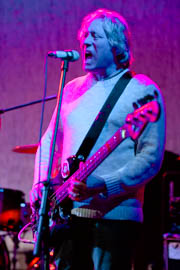
This Hammerhedd performed as a quartet with Ben Dresbach joining brothers Henry, Abe, and Eli Ismert. Henry led the band and began by inviting everyone toward the stage – most by name. The set started with Henry on bass, Abe on keyboards, Eli on drums, and Dresbach on saxophone. Later that would shift. Vocals were split between Abe and Henry. Sometimes there were harmonies. The act's music was choppy, quirky post-punk, with the strangest moments bordering on no wave, while the most developed songs recalled the indie of Morphine. Midway through the thirty-five-minute set, Henry handed his bass to Abe and picked up a guitar. This second configuration focused on longer songs. Some (like the closer) developed nicely. Others went nowhere. Henry stomped about the stage, making faces and kicking like an energetic donkey. It was at that point that I remembered a viral video from 2016 with three little kids (age 4, 7, and 9) covering Metallica. Turns out that this indie rock Hammerhedd was that death metal Hammerhedd all along. Another mystery solved.
I've video of the band, but the foursome is intent on keeping some things secret I guess?
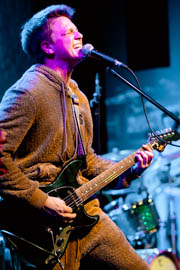
There was nothing quite so enigmatic about Dan Jones and the Squids. The trio featured the titular vocalist/guitarist Dan Jones, bassist Steve Tulipana, and drummer Matt Ronan and played pop rock heavy on melody and infused with subtle punk daring. A few cuts in the thirty-minute set tightened to power pop. Fewer still stretched out into dreamy and twangy Americana. "Frog in a Pail" nailed the latter, sounding like a warm summer night and recalling the contented haze of Wussy. There was little banter during the set, and a whole lot of feels.
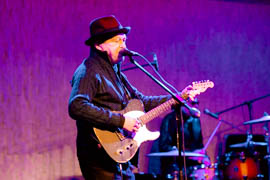
It wasn't even fifteen minutes later that Richard Lloyd took the stage flanked by bassist Sean Seymour and drummer Kevin Tooley. Lloyd rose to fame in the mid-1970s as the co-founder and guitarist of New York City's Television. Although his guitar work in the seminal act was rightly recognized as groundbreaking, his vocals and compositions were generally overshadowed by his bandmate Tom Verlaine. Lloyd's later solo work has been solid, but it's never found the audience that Television did. Still, at 9:00 several dozen greying fans lined the stage to see the legend perform. Behind them a score of kids who had come to support Hammerhedd decided to stick around to see what the old man was all about.
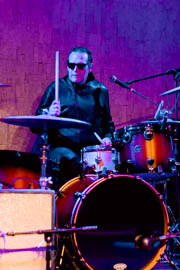
A fifteen-song setlist sat on the stage floor, but it was soon apparent that it was more of a menu than a roadmap. The resulting set was abbreviated but still pleasantly comprehensive. Lloyd started with the mid-career "Secret Words" and "Strangestrange," tossed in several Television numbers ("See No Evil," "Friction," "Ain't That Nothin'"), added one early solo career ("Number Nine"), and closed with a couple of covers from The Count Five and The Byrds. Much to my delight, he even played the jangly cut he penned for Chris Stamey and the dBs ("I Thought You Wanted to Know"). Lloyd didn't speak a word until after the fifth song, at which point he explained that he had laryngitis. His voice did sound worn, but at seventy-four, I suspect it does even in perfect health. His fingers were up to the task though, offering leads and solos that were both bluesy and melodic. The bending solo in "Black to White" was a highpoint as was his raucous work in "Friction." Seymour's bass was simple, offering few runs or flash, but his backing vocals in "Strangestrange" certainly elevated the track. Tooley's drumming was similarly utilitarian, though that turnaround in "Ain't That Nothing" was a delight. How he drummed in that bulky leather jacket for so long is a mystery, but any man who wears sunglasses that dark must certainly enjoy being mysterious.
The night ended with an epic cover of "Eight Miles High." Lloyd noted that it was a good one to "stretch out on," and he was true to his word. Tooley even got a drum solo. Did seeing Richard Lloyd make up for having never caught Television in their glorious prime? Of course not, but not only did Lloyd do them justice, he also proved that he has a deep catalog of excellent songs, an ear for melody, and improvisational instincts that make his shows one hell of a night out.
After the lights came up I joined a debate on what the best version of "Eight Miles High" might be. Kate was a vocal supporter of Husker Du's telling, while Randy thought the title belonged to The Hang Ups. And although Sherman wanted more time to ponder the question, we all agreed that Richard Lloyd's telling belonged in the discussion. And with that more or less tabled, and all my other questions answered, I hurried home to my late dinner.